In the packaging industry, corrugated boxes are the primary choice for safely shipping goods of all types. The ability of these boxes to withstand external pressure during storage and transit is crucial to the protection of their contents. Test af topbelastning is a widely recognized method for evaluating a box’s resistance to compressive forces, simulating the weight and pressure exerted when boxes are stacked. In this article, we will explore the importance of Test af topbelastning, the relevant ASTM D2659 standard, and how to perform these tests using a top load tester.
Understanding Top Load Testing for Corrugated Boxes
Top load testing measures the ability of a corrugated box to withstand pressure when subjected to a load from above. It simulates the conditions a box will face when stacked with other boxes during transportation or storage. The purpose of the test is to ensure that the box maintains its structural integrity and does not collapse under pressure, thus preventing damage to its contents.
In Test af topbelastning, a compressive force is applied to the top of the box, typically through a mechanical press. The test measures the amount of force required to deform the box, which helps in determining the box’s compression strength.
The Significance of Top Load Testing
- Protecting Contents: Boxes that cannot withstand the weight of other stacked boxes may result in damaged products. Top load testing ensures that packaging is strong enough to protect the goods during transit.
- Improving Packaging Design: By performing Test af topbelastning, manufacturers can optimize their box designs to balance durability with material cost.
- Compliance with Industry Standards: Many industries require compliance with standards like ASTM D2659 to ensure the packaging meets the necessary performance criteria.
- Customer Satisfaction: Durable packaging reduces the chances of damage during transport, enhancing customer satisfaction and minimizing complaints.
ASTM D2659: The Standard for Top Load Testing
ASTM D2659 is the international standard for Test af topbelastning of packaging, specifically for containers made from thermoplastics and other materials. Although initially developed for blow-molded containers, the ASTM D2659 standard can be applied to corrugated boxes and other packaging types that are subjected to compressive forces.
The Significance of ASTM D2659 in Packaging Design
- Evaluation of Box Strength: ASTM D2659 provides a standardized method for evaluating the strength and durability of corrugated boxes and other containers, ensuring that they meet the required performance standards.
- Design Optimization: By adhering to ASTM D2659, manufacturers can design boxes that provide adequate protection while minimizing material costs and weight.
- Quality Control and Specification Compliance: This test method ensures that boxes meet industry standards, making it essential for quality control in manufacturing processes.
Using the Top Load Tester for Accurate Testing
Den top load tester is a critical tool for performing Test af topbelastning on corrugated boxes. This testing machine applies a controlled compressive load to the top of the box, allowing manufacturers to measure the box’s resistance to pressure and determine its structural strength.
Features of the Cell Instruments Top Load Tester (TLT-01)
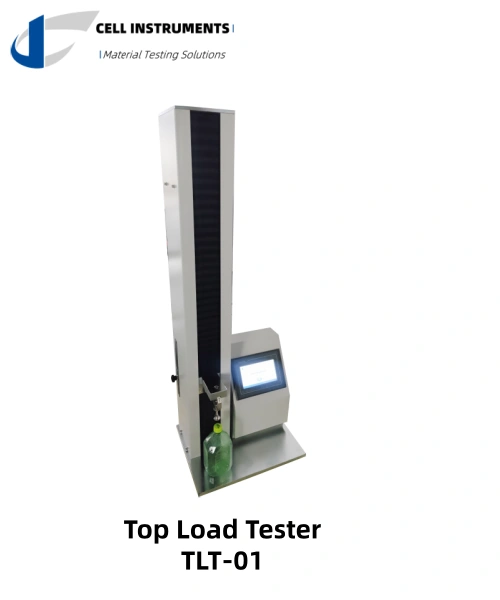
- Ease of Use: The user-friendly interface ensures that the test can be conducted quickly and efficiently, with minimal setup time.
- Precision: The Cell Instruments Top Load Tester TLT-01 offers precise control over load application, allowing for consistent and repeatable results.
- Versatility: The TLT-01 can be used for a wide range of packaging materials, making it suitable for testing corrugated boxes, blow-molded containers, and more.
- Compliance: The TLT-01 is designed to meet ASTM D2659 standards, ensuring that your packaging is tested to the highest industry standards.
By incorporating the TLT-01 into your quality control process, you can ensure that your corrugated boxes meet the necessary strength requirements, reducing the risk of damage during transportation and improving overall packaging quality.
How to Conduct Top Load Testing Using a Top Load Tester
Performing Test af topbelastning using a top load tester involves several key steps:
- Specimen Preparation: Prepare the corrugated box according to the required size and material specifications. Ensure that the box is free from defects and properly conditioned for testing.
- Load Application: Place the box on the testing platform and apply the compressive load using the top load tester. The load is gradually increased until the box begins to deform or reaches its maximum load capacity.
- Data Recording: The tester records the force required to compress the box, along with any significant deformation or failure points. This data is used to assess the box’s compression strength.
- Analysis: Review the results to determine whether the box meets the required standards for strength and durability.
Conclusion
Test af topbelastning is a critical process for evaluating the strength and durability of corrugated boxes. By adhering to the ASTM D2659 standard, manufacturers can ensure that their boxes will perform well under compressive forces during transport and storage. With the help of advanced testing equipment such as the Cell Instruments Top Load Tester TLT-01, manufacturers can optimize their packaging designs, improve quality control, and meet industry standards. Conducting regular Test af topbelastning ensures that packaging remains strong and reliable, providing better protection for products and improving overall customer satisfaction.
 DA
DA  EN
EN  AR
AR  BG
BG  CS
CS  DE
DE  EL
EL  ES
ES  ET
ET  FI
FI  FR
FR  HU
HU  ID
ID  IT
IT  JA
JA  KO
KO  LT
LT  LV
LV  NB
NB  NL
NL  PL
PL  PT
PT  RO
RO  RU
RU  SK
SK  SL
SL  SV
SV  TR
TR  UK
UK